The Dôme des Invalides, top to bottom
Two churches back to back
This is the point almost nobody knows, and it explains the plan. Les Invalides has two churches joined together: to the north the Saint-Louis cathedral, the soldiers', plain and long; to the south the Dôme, the king's, centralised and sumptuous. They touch. Originally a glazed bay let the king, from his church, see the shared altar he had in common with the pensioners. One liturgy, two social conditions, two doors. That is the Grand Siècle in its purest form, and it is still visible today: see the cathedral page.
The cupola
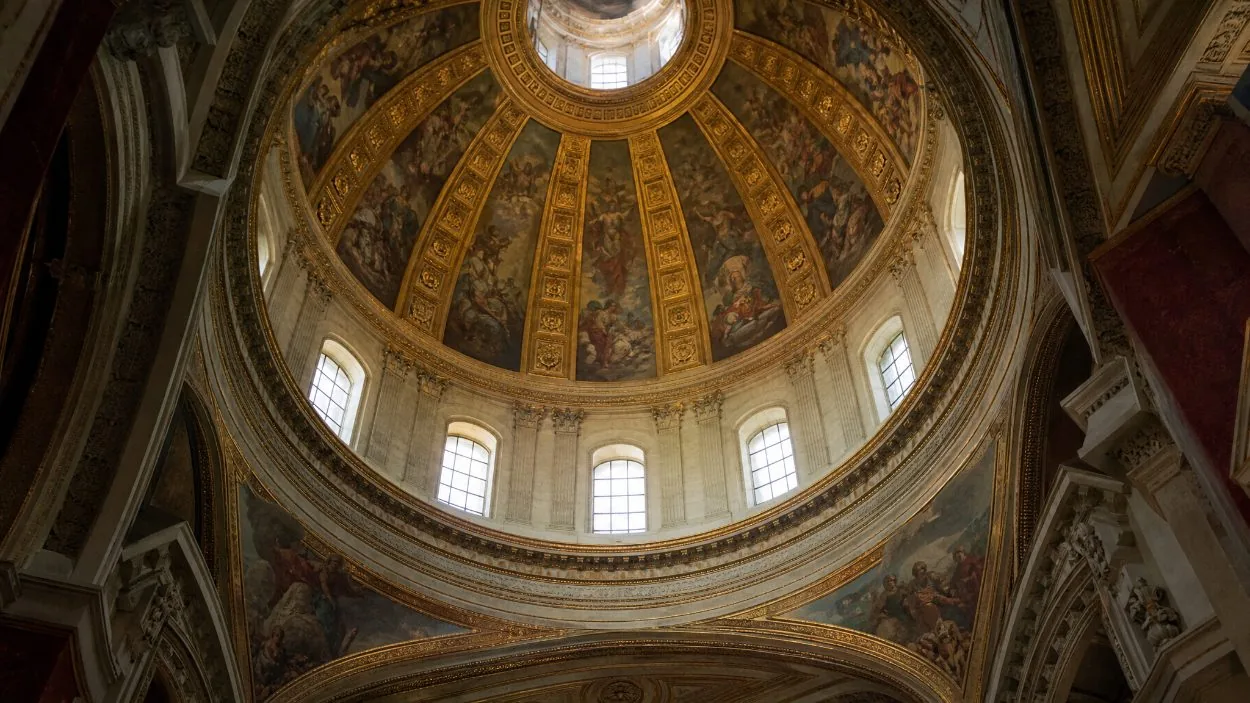
Hardouin-Mansart superimposed three shells, which lets the interior fresco be lit by a lantern invisible from the floor. The cupola painting is by Charles de La Fosse: Saint Louis presenting his sword to Christ, within a glory. The pendentives and the chapels were painted by several of the great decorators of the period. Look up before you look at the crypt: that is the logical order, and the opposite of what most visitors do.
The gold on the outside
The outer dome was gilded in 1706, then under Napoleon in 1807, under Napoleon III in 1869, and last in 1989 — that campaign used 12.65 kilos of gold in leaf. The technical detail and the figures are on the gilding page.
The hole of 1842
When the tomb had to be installed, the architect Louis Visconti took a radical decision: he opened the floor of the church to cut a circular crypt and set the sarcophagus at the bottom of it. The visitor therefore looks downwards. It is a gesture without equivalent in French funerary architecture, and it turned a building of Louis XIV into an imperial mausoleum without destroying anything. The twenty years of work also explain why the body spent so long in a side chapel: that is told on the tomb page.
Walk round the outside of the Dôme from the avenue de Tourville and the Place Vauban before you go in. Close up you can see the gilded trophies and the proportions of the drum; from the esplanade you only see a silhouette.
Going in under the Dôme
Entry to the Dôme is included in the Les Invalides ticket. Availability is below.
A reminder: what you book above is the ticket that opens the Army Museum, the Dôme and the tomb. The great courtyard and the Saint-Louis cathedral stay free to enter, with no ticket at all.
Frequently asked questions
Who built the Dôme des Invalides?
Jules Hardouin-Mansart, between 1677 and 1706, as a royal church.
Who painted the cupola?
Charles de La Fosse, with Saint Louis presenting his sword to Christ.
Was the Dôme built for Napoleon?
No: it predates him by a century and a half. The crypt was cut in 1842.
How much gold is on the dome?
12.65 kilos for the 1989 gilding: see this page.